


Teambuilding with wargames
Why wargaming?
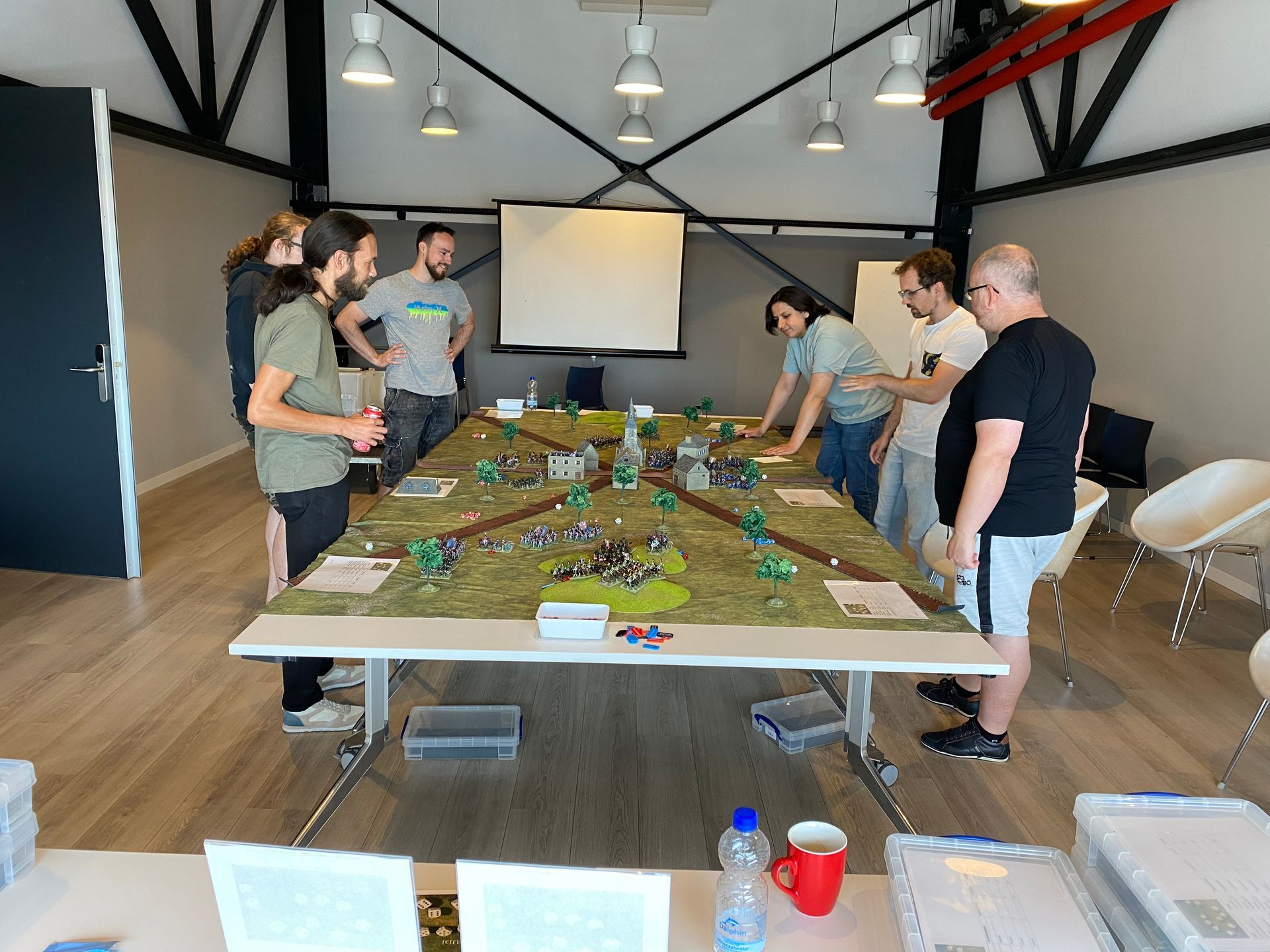
Good organisations invest in their people. They attempt to improve the behaviour that people display when they are working together. Profiling such as DiSC or management drives tend to wear off after a month or so, and people go back to their usual day to day business afterwards. It would be much more effective to actively train to work as a team.
In its essence, teambuilding is about play, bringing co-workers into an unfamiliar environment and letting them interact and learn to cooperate together. It is not such a big leap to be playing wargames to learn these skills. The idea using board games or making ‘role-play’ scenarios is nothing new (usually white board exercises with post it notes). Using tabletop boardgaming with miniatures to do this is new.
The idea came about during an evening’s playing with friends. The hour was late and alcohol was involved, but we noticed that our opponents were not working together anymore. They were still playing the game, but just not cooperating. It then became possible for our side to exploit this and to win the game. Given equal forces on both sides, winning or losing the game should be even odds. As our opponents were not a team, the side which did work as a team could defeat its enemies in detail. This concept was revived recently after I graduated as a military historian, last year.
Teambuilding and wargaming
As Peter Perla, author of The Art of Wargaming, has so eloquently put it: @G: ‘Wargaming is about making decisions in a competitive environment and dealing with the results of those decisions in that same environment.’
It is therefore an ideal method to practise the decision making processes. One may not be aware of the processes involved when playing a game as a hobbyist, but the process is real nonetheless.
Again, in the words of Peter Perla: ‘Wargaming entertains, for it stirs the imagination, wargaming is a learning experience, for it triggers the intellect and wargaming engages, for it stimulates the intuition.’
So, if that is the case for us wargamers, then why wouldn’t it work in a corporate environment? Wargames are, after all, all about human interaction, just like teambuilding sessions are. Could we, by means of wargaming, let people learn something about themselves and their teams? It was with this this question in mind that we began to develop BelloLudi.
Wargaming is not very big in the Netherlands as it is in the Anglo speaking world. There are a little more over a thousand members on the Dutch Miniature wargame page on Facebook and the miniature buy and sell page has around 1800 members. A lot of those memberships overlap each other. So, on a population of 17 million people, it is not very much. The chances of finding wargamers in a teambuilding session will be very slim indeed. That in itself doesn’t have to be a problem, but the basis concept of a wargame will have to be explained in a short period of time as it is essential to get the team playing the game and interacting with each other as quickly as possible. People are there to play, not to hear a lecture about military history in general or the history of wargaming in particular. They just want to get on with it.
On the other hand, us wargamers do tend to use a lot of military jargon. Players have to be acquainted with at least some of the terms used in describing battles of the nineteenth century. A period we deliberately chose as to avoid the bad tastes that World War Two left behind. People in the Netherlands can still be sensitive about that period. The second reason we chose the Napoleonic period is that the uniforms are predominantly blue for the French and red for the British. That would help our players in identifying the playing pieces. The third reason is off course the look and feel of this period. People are genuinely impressed by the looks of a Napoleonic table with all the flags, horses and the odd tree and building.
In our short introduction, we tell them what cavalry is (those miniatures on horseback), infantry (the models on foot) and artillery (the canon). As you can tell this is all very basic. We inform the players about battalions and brigades, what formations were used and how the rules work. We also send the rules in advance as a sort of teaser or primer, so that the players can read into the rules beforehand. We also tell a little story on how this battle is firmly placed in history. The fact that it is a fictitious battle has yet to be challenged.
As it is imperative for a teambuilding session for the participants to interact and work together towards a common goal, we decided that every player would be commander of a brigade. A brigade of infantry consists of four battalions of 24 figures and a cannon. A brigade of cavalry consists of three squadrons of twelve miniatures and a gun. Sides are decided by pulling a blue or red chip out of a bag, so that is randomised. Or, should the client wish so, could be determined in advance. Then, the teams will have to choose their overall commander. That is an interesting process in itself and gives ample opportunities for interventions and reflections on the normal day to day working situation. It is for the facilitator to pick up those signals and to address them either immediately or during the debriefing. Is it the manager, or will they chose the silent one that quietly admits that he, or she, has a couple of games under his/ her belt. Does the team want traditional leadership or situational leadership and why?
With the players’ sides decided and commanders chosen, we give the commanders their written orders. It is for them to come up with a plan of action, with their team preferably, and some sort of consensus on how to execute that plan. As the commanders are given their instructions, it is interesting to see how they share those with their subordinates. These moments are crucial. Not only for the commander, but also the team. Does the team come together or not, discuss the instructions? Is everybody allowed to speak his mind? What kind of atmosphere does the general create?
Then the games starts proper. After both sides have played their turn, it is time for the debriefing in which the teams reflect on how they performed on the initial plan and if there should be any adaptation of the plan to the new situation. As we all know, no plan survives first contact with the enemy. It is in these debriefing settings that interventions can take place and players can reflect on each other’s behaviour. Any profiling, such as DiSC, that has already been done, can be very helpful in these interventions. It will also make the profiling stick better.
In the last game I had two very different management styles working on the same table. One general was constantly moving up and down the battlefield. Encouraging his brigadiers and helping them out with the cards we also use in the game or the re-roll he had been given. On the other side the commander spoke out several times that he did not understand the game that well and although some of his brigadiers picked up the game rather fast, there was no one helping him. As a result, little coordination occurred on that side. Yes, It can be lonely at the top. You can guess which side was the successful one.
Building the ideal team game
As teambuilding or leadership training is the goal, the game could be no more than a means to an end. As we needed to get the teams moving into the game rather quickly, we decided to use a very simple set of rules, inspired by the <i>Black Powder<i> rules, which we find easy to use. I made a translation of the quick reference sheet and supposed that that would suffice to play the game with a group of people uninitiated in wargaming. Although the game was downsized to just two pages, there were still a lot of detailed rules interfering with the outcome of the dice roll which were not obvious to the players.
During our first testing sessions we received two kinds of feedback. The need for simpler rules and the speed of the game. In short, not too many variables. This has resulted so far in in a brand new ruleset of only ten pages called BelloLudi (reviewed this issue Ed) with no more rules pages than the game of RISK, known to many outside the wargame community. The challenge was to avoid the simple dice-off of RISK and concentrate on the decision making. Players have to make choices and deal with the consequences.
Further playtesting revealed that the rolling dice sequences in lots of wargames is rather counterintuitive for non-wargamers. First, one has to roll a low number on two dice to get your command moving, and the next moment, one has to roll as high as possible in order to keep your command on the table. The first dice roll we adapted for quick gaming purposes was the command roll. As a trained Black Powder player, working out the number of moves is something that comes almost natural when rolling two dice. However, it was too much ‘magic’ for the uninitiated, so now the number of moves is determined by one customised D20. It is now possible to play with twenty people and come to a conclusion in two hours.
Black Powder does have rules for psychology. Will your troops stand or will they run? It turned out that testing was not the real problem, but when to test had to be clear. So we decided to drop testing except for losing hand to hand combat. Taking a unit off the table is determined by the number of chips it has collected. Seven hits, they are out!
We found the I-go You-go sequence could be counterproductive for teambuilding games. In the teambuilding sessions, we found that whenever side A was executing their turn, the other side seemed to dose off a little. We countermanded that by instructing them to tell their opponents their orders instead of just talking into thin air, making it more interactive for both sides. Again, communication is key. Also, the cards help here. As they are allowed to be played at any time during the game, keeping both sides sharp.
Conclusion
Teambuilding with wargaming does work, even with the uninitiated. It does however take the right game which forces people to interact, work together and deal with each other’s strengths and weaknesses by communicating and showing leadership. In fact, the interaction between players is the goal of teambuilding and as such more important than the game itself. The game has to be fast and with not too many details. This means that, as a wargamer, you will have to lose more than a few paradigms. If done successfully, players will gain a lasting experience and confidence when they have completed a complex task (i.e. the game) and in the process have learned about each other and how best to work together.